
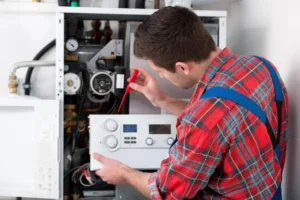
A specialist in a red plaid shirt diagnoses a modern high-efficiency boiler system by accessing the internal digital control panel.
Although cold plunges have been a trend over the last few years, let’s face it: if you’re not expecting it, a cold shower is a brutal way to start your day. Perhaps, in fact, the worst way to start your day.
One minute you’re enjoying the steam, the next you’re hit with an icy blast that sends you scrambling. That sudden temperature drop is a clear sign you might need emergency hot water heater repair.
Or maybe you noticed a strange puddle forming around the base of the tank, or heard a sound like popcorn popping from inside.
These are all signals from your water heater that it’s in distress. Before panic sets in, let’s walk through what’s happening and, more importantly, what you can do about it.
No Hot Water at All?
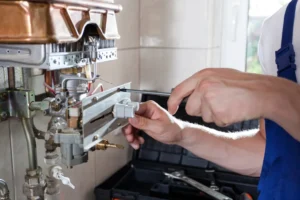
A close-up view shows a technician using a screwdriver to carefully repair the complex gas burner and ignition assembly of a tankless water heater.
The most common problem is simply a total lack of hot water. It’s inconvenient, but it’s not always a catastrophe.
Your first move will depend on the type of water heater you own: gas or electric.
If you have an electric water heater, head to your circuit breaker panel. An electric heater uses a lot of power and can sometimes trip its dedicated breaker. Find the switch labeled “Water Heater” and see if it’s in the ‘off’ or middle position.
Flip it all the way off, then back on. Sometimes, that’s all it takes. If it trips again right away, there’s likely an electrical issue with one of the heating elements or thermostats inside the tank.
For gas water heaters, the problem is usually the pilot light. It’s a tiny, continuous flame that ignites the main burner when needed. If it goes out, the burner won’t fire up, and you won’t get any hot water.
Check the access panel near the bottom of your tank. You should see instructions printed there for relighting the pilot. Following them carefully usually resolves the issue. If the pilot won’t stay lit after several tries, you probably have a faulty thermocouple, a safety device that needs replacement.
“My Water Heater is Leaking!”
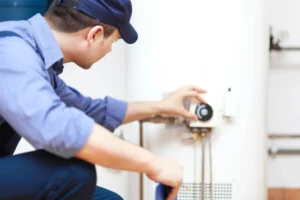
A repairman kneels beside a white water heater tank to adjust the temperature control dial during a routine maintenance check.
Seeing water pool around your heater is a much more urgent situation, since a leak can cause significant water damage to your floors, subfloors, and walls. You’ll need to find the source of the leak if you want to determine the severity.
First, find the cold-water shut-off valve. It’s usually a lever or wheel-style handle on the pipe leading into the top of the tank. Turn it clockwise to stop more water from entering. This doesn’t solve the problem, but it does contain it while you troubleshoot.
Now, try to identify where the water is coming from. If it’s dripping from the pipes connected to the top of the tank, you might just have a loose connection that needs tightening. If it’s coming from the temperature and pressure (T&P) relief valve on the side of the tank, the valve might be faulty or doing its job because of excessive pressure inside.
The worst-case scenario is water seeping from the bottom of the tank itself. This almost always indicates that the inner tank has rusted through and failed. Unfortunately, this is not a fixable problem. The only solution is a full replacement, and it’s definitely time for an emergency call.
Weird Noises and Smelly Water
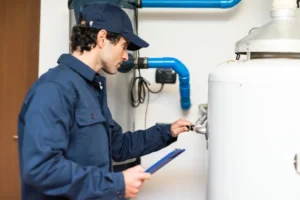
A service technician in a navy uniform and cap performs a safety inspection on the pressure relief valve of a residential water heater.
Your water heater should be relatively quiet. If you start hearing loud pops, bangs, or rumbling sounds, you’re hearing the effects of sediment buildup.
Over the years, minerals from your water supply settle at the bottom of the tank. When the burner or heating element kicks on, it boils the water trapped underneath this layer of sediment, causing those startling noises. This process is inefficient, strains your heater, and can lead to premature failure. Flushing the tank can remove this sediment and quiet things down.
What about stinky water? If your hot water smells like rotten eggs, you’re dealing with a chemical reaction inside the tank, which is caused by bacteria interacting with the anode rod, a component designed to prevent corrosion. While it’s not dangerous, it’s unpleasant.
A professional can flush the system and replace the standard magnesium anode rod with an aluminum one, which often solves the problem.
When It’s Time to Call for Help
You can handle a tripped breaker or relight a pilot light. You might even feel comfortable tightening a leaky pipe connection. But some jobs are best left to a professional. If you’re dealing with a major leak from the tank itself, have a gas heater that won’t stay lit, or if you suspect an electrical fault in your electric model, it’s time to call for backup. Working with gas lines and high-voltage electricity is risky without the right training and tools.
An experienced technician can diagnose the problem quickly and safely, determining if a simple part replacement will do the trick or if the unit has reached the end of its lifespan. They’ll also have the right parts on hand to get your hot water running again without multiple trips to the hardware store.
For a fast and reliable fix, you don’t want to guess, but don’t spend another minute shivering. If you’re facing a water heater crisis in the Edmond area, give Edmond Appliance Repair a call.
In addition to repairing other common appliances, from freezers to washing machines, we also handle emergency hot water heater repair. We have the speed and expertise you need to get your home (and your morning shower routine) back to normal.
Leave a Reply
You must be logged in to post a comment.