
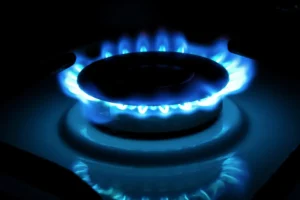
Close-up of a clean, steady blue flame on a gas cooktop burner, signifying proper function.
You prep a beautiful roast, season your vegetables perfectly, and turn the dial on your kitchen range. Nothing happens.
You hear a faint clicking sound, but the heat never arrives. Your dinner plans immediately crumble.
Your first instinct might be to grab a toolbox and watch a quick video tutorial online. Fixing things around the house, after all, feels incredibly rewarding.
And while you may have been able to DIY an ice maker repair or a leaky faucet, taking apart a combustion appliance crosses a line, as messing with natural gas brings severe risks into your home. Let’s look exactly at why you need to step away from the wrench and call a professional for gas oven repair instead.
The Invisible Threat of Carbon Monoxide
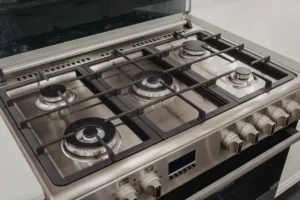
High-angle shot of a clean, five-burner stainless steel gas range and oven.
Natural gas powers your kitchen efficiently, but it requires precise handling at all times. When your appliance functions correctly, it burns fuel safely and vents the exhaust away. But when you tinker with the internal components, you risk altering that delicate combustion process. Incomplete combustion produces carbon monoxide. This invisible, odorless byproduct quickly fills your kitchen without you ever noticing.
According to the Centers for Disease Control and Prevention, over 400 Americans die from unintentional carbon monoxide poisoning every single year. You can’t smell it or see it, so a simple mistake during a weekend project could easily turn your kitchen into a silent hazard.
You might think you tightened a supply valve perfectly, but a microscopic gap allows deadly exhaust to escape into your living space. Symptoms like headaches and dizziness creep up slowly, making this one of the most dangerous risks of amateur plumbing work.
Fire Hazards and Explosive Mistakes
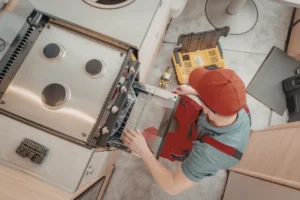
Overhead view of a professional technician repairing a gas oven range in a modern kitchen.
Beyond carbon monoxide, you face the immediate threat of a catastrophic fire. Natural gas is highly combustible. That makes it great for cooking steaks, but terrible for amateur repairs. If you accidentally pinch a supply line or strip the threading on a brass connector, raw fuel will leak directly into the chassis.
The National Fire Protection Association reports that cooking equipment causes 44 percent of all reported home structure fires. You absolutely don’t want to add to that terrifying statistic. A tiny leak inside the metal cavity only needs a single spark to ignite. The friction from a dropped screwdriver or the click of the electronic surface igniter provides enough energy to cause an explosion.
A proper gas oven repair requires strict safety protocols that the average homeowner simply doesn’t know, but professionals understand exactly how to purge the lines and secure the fittings to prevent such disasters.
Voiding Your Safety Nets
Appliances come with strict warranties for a very specific reason: manufacturers know that specialized equipment needs specialized care. If you open up the back panel and start twisting delicate valves, you instantly void your manufacturer’s warranty. If your DIY fix fails and destroys the main control board, you will pay completely out of pocket for a brand new unit.
Your home insurance policy operates under similar rules. Insurance companies expect you to maintain your property safely and legally. If an insurance adjuster discovers that a kitchen fire started because you attempted an amateur gas oven repair, they can legally deny your entire claim. You risk your life, your house, and your financial security all to save a few dollars on a standard service call.
Complex Valves and Delicate Sensors
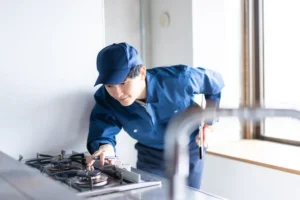
Appliance repair expert in uniform inspecting gas stove burners for safety and performance.
Modern ranges contain incredibly complex internal systems, relying on a network of temperature sensors, safety valves, and electronic control boards that work in perfect harmony. The bake igniter does much more than just create a glowing spark. It must draw a very specific electrical current to signal the bi-metal safety valve to open.
If you replace the factory igniter with a cheap aftermarket part, it might not draw the correct amperage. The valve could remain permanently shut, or, worse, open partially and leak raw fuel into the burner tube. Thermocouples and temperature probes require precise calibration, too. If you bump a sensitive probe while trying to clean a rusty burner, your food will never heat properly again.
Professional technicians, on the other hand, understand these intricate relationships. They diagnose the root cause rather than just swapping out random parts and hoping for the best.
Missing the Right Diagnostic Tools
You probably have a great set of screwdrivers and a reliable socket wrench in your garage. Those tools work wonderfully for building patio furniture or fixing a leaky bathroom faucet, but they fall short when it comes to major kitchen appliances. Proper diagnostics require specialized, expensive equipment that you won’t find at a basic hardware store.
Technicians use digital manometers to measure the exact pressure inside the supply lines. They use professional multimeters to test the ohms and voltage running through the igniter circuit. They also carry electronic combustible leak detectors that pick up trace amounts of mercaptan (the chemical that gives natural gas its rotten egg smell) far better than your nose ever could. Without these specific tools, you’re simply guessing. Guessing leads to mistakes, and mistakes lead to dangerous leaks.
Understanding the Physical Toll
Taking apart a heavy kitchen range takes a massive physical toll: you have to pull a heavy metal box away from the wall without scratching your floors. You have to remove heavy cast-iron grates, unhinge a cumbersome glass door, and contort your body to reach the lower burner tubes.
The internal screws often rust or fuse together due to years of exposure to high heat. If you strip the head of a rusted screw while trying to remove the floor plate, your project comes to a grinding halt.
You’ll find yourself trapped in a messy kitchen with appliance parts scattered across your cooktops or countertops. Hiring a professional saves your back, protects your flooring, and keeps your kitchen clean. And more importantly, it keeps your sanity intact.
Leave the Heavy Lifting to the Experts
Your kitchen should remain a place of comfort and great food. It should never become a testing ground for risky amateur plumbing experiments. When your appliance refuses to heat up, you need a safe, reliable, and permanent solution. You need someone who understands the exact science of combustion and electrical circuitry.
That’s exactly what we provide. Edmond Appliance Repair handles all types of gas oven repairs with absolute precision and care. We bring the right diagnostic tools, the correct factory replacement parts, and years of hands-on experience directly to your home. We’ll find the broken component quickly, test the entire system thoroughly, and guarantee your kitchen operates perfectly safely.
Don’t risk your home or your personal safety on a frustrating weekend project. Contact Edmond Appliance Repair today to schedule your service and get your kitchen running safely again!
Leave a Reply
You must be logged in to post a comment.